 Bosnia

About Jadranka Stojaković
Jadranka Stojaković was a Bosnian singer-songwriter of light music and urban chanson, born on 24 July 1950 in Sarajevo into a family of school teachers. Her parents first taught in a village near Bosanski Novi; after they divorced, she moved with her mother between Dubrovnik, Gradac na Moru, Vareš and villages around Sarajevo, wherever her mother found teaching work.
At sixteen she joined the jazz group of her uncle Vukašin Radulović and toured Yugoslavia and parts of Europe, mostly Germany. From 1972 she sang at the big Yugoslav festivals: at Vaš šlager sezone in Sarajevo from "Pajaco" (1972) to "Golube" (1988), which won the third audience prize and the prize for best lyrics; at Beogradsko proleće, Opatija and Zagreb; and at Omladina in Subotica, where "Ti ne znaš dom gdje živi on" won the first audience prize in 1973 and "Muzika je svirala" was sung with S Vremena Na Vreme in 1974. In the late 1970s she began setting poems by Aleksa Šantić and Desanka Maksimović in new arrangements, and she wrote music for Television Sarajevo, including children's programmes.
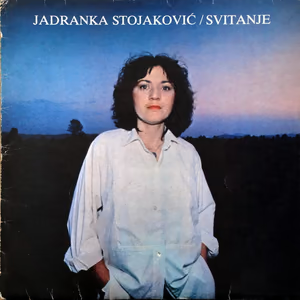
Her albums "Svitanje" (1981) and "Da odmoriš malo dušu" (1982) came out on Diskoton, "Sve te više volim" (1985) on Sarajevo disk and "Vjerujem" (1987) on PGP RTB. In 1981 she sang backing vocals with Ismeta Dervoz and Neda Ukraden for Vajta's "Lejla" at Eurovision in Ireland, and for the 1984 Winter Olympics in Sarajevo she wrote and sang the opening theme. Her best-known songs include "Sve smo mogli mi", "Ima neka tajna veza", "Što te nema", "Bistre vode Bosnom teku", "Muzika je svirala" and "Čekala sam".
In 1988 Jadranka Stojaković moved to Japan, where she lived until 2011. She worked for Konami and released "Sarajevo balada" (1994), "Baby Universe" (1996) and "Otoiro – Adriatic Muse On The Cruise" (2007) on Omagatoki Records. The Japanese name of the Pokémon Slowbro, Yadoran, comes from her, suggested by a former Konami colleague.
In 2009 she tripped over a cable on stage and was injured, and she was diagnosed with amyotrophic lateral sclerosis. In 2011 she returned, settled in Banja Luka, released "Daleko" on Croatia Records and worked as a music editor at Radio-Television of Republika Srpska. Fellow musicians held benefit concerts for her in 2012 and 2016. Jadranka Stojaković died in a Banja Luka nursing home on 3 May 2016 and was buried at the Vrbanja cemetery. Branko Lazić directed the film Jadranka about her life, and in 2024 Festival Kantarion gave her a posthumous award for her lifetime contribution to music.
Known for
- Sve smo mogli mi
- Muzika je svirala
- Što te nema
- Bistre vode Bosnom teku
- Ima neka tajna veza
- Čekala sam
- Golube
- Vjerujem

 Serbia




 Croatia